Citi Global Market is not licensed – it claims to be, in several jurisdictions, as you can see below:
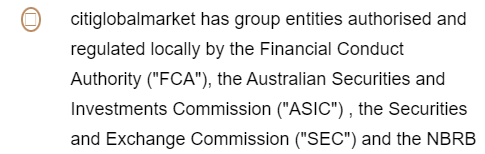
However, everyone can claim to be licensed – legitimate brokers also provide us with license numbers that can be used to look them up in the databases of the regulatory bodies. Furthermore, Citi Global Market can be found in the following warning issued by the CySEC:
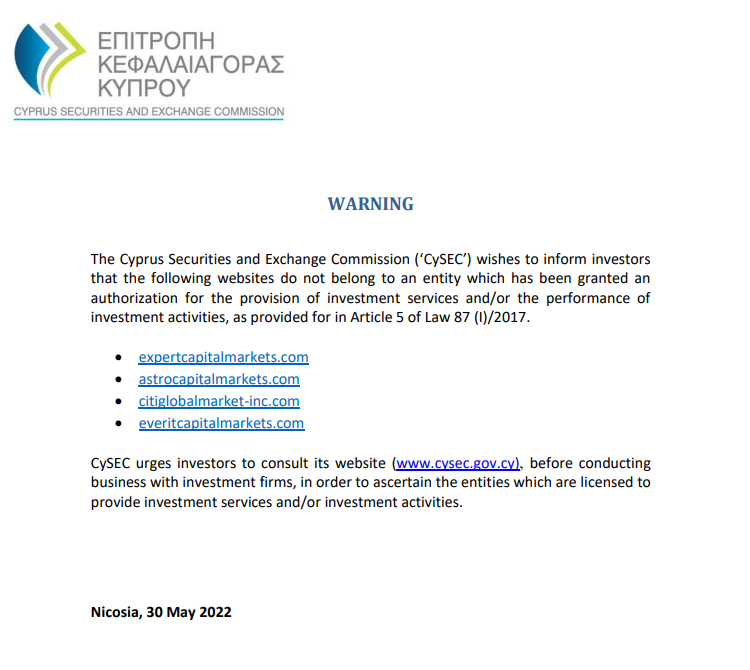
This means Citi Global Market is a scam and further cements the fact it does not hold a license from any regulator – a fact which makes Citi Global Market a most dangerous firm!
What are the risks of trading with unlicensed companies?
As shown above, the company is completely unregulated. This means the people behind it are free to do with your money as they see fit. Of course, there is no shortage of scams companies that are unlicensed. The criminals take advantage of the fact there is no oversight on their activities and sometimes straight up steal their victims’ deposits.
And even if you are dealing with an unlicensed firm that is actually not out to scam you, your money will still be exposed to high risks. This is because scammers are just one of the many dangers to dealing with unlicensed companies. Others include dealing with companies that are just not good enough to handle your money, or are operated poorly and go under as a result, taking your money with them. You could also be dealing with a firm that engages in financial crime, like money-laundering or financing terrorism and so on.
Regulatory frameworks around the world
To make sure that is not the case, and to ensure your safety, it is important to make sure that you are dealing with a company that is registered with a respected regulatory body. There are many such bodies in the world, but most of them have similar policies in place to provide it to you.
One of them is the minimum capital requirement – it is in place with most regulatory bodies, albeit with a different size. For example, the minimum capital requirement imposed by the UK’s FCA is €730 000, while the US regulators, the NFA and the CFTC have one of $20 million. However, both policies are effective in making sure the only companies that receive the approval of the regulators are fit to offer their services on the respective markets.
Another interesting policy is the requirement for the companies to keep client funds segregated from their own – this makes it so in the case of a firm defaulting, the creditors of that firm will not be able to take the clients’ money, just the one belonging to the firm. These policies are enforced by the majority of regulatory bodies around the world and embraced by more and more of them. Just in 2021, the Australian ASIC has started enforcing the policy as well, for example.
>> Best Regulated Forex Brokers <<
The majority of jurisdictions also have firms comply with Anti money laundering (AML) and Know Your Customer (KYC) policies as well, which means they cannot contribute to the financial crime we mentioned.
As you can see, doing business with a licensed firm is a much better idea than investing with a company that is not under anyone’s oversight!