MarketsOctaFX is an outright scam and that is clearly evident from the recent warning of the financial authorities in Cyprus. Take a look:
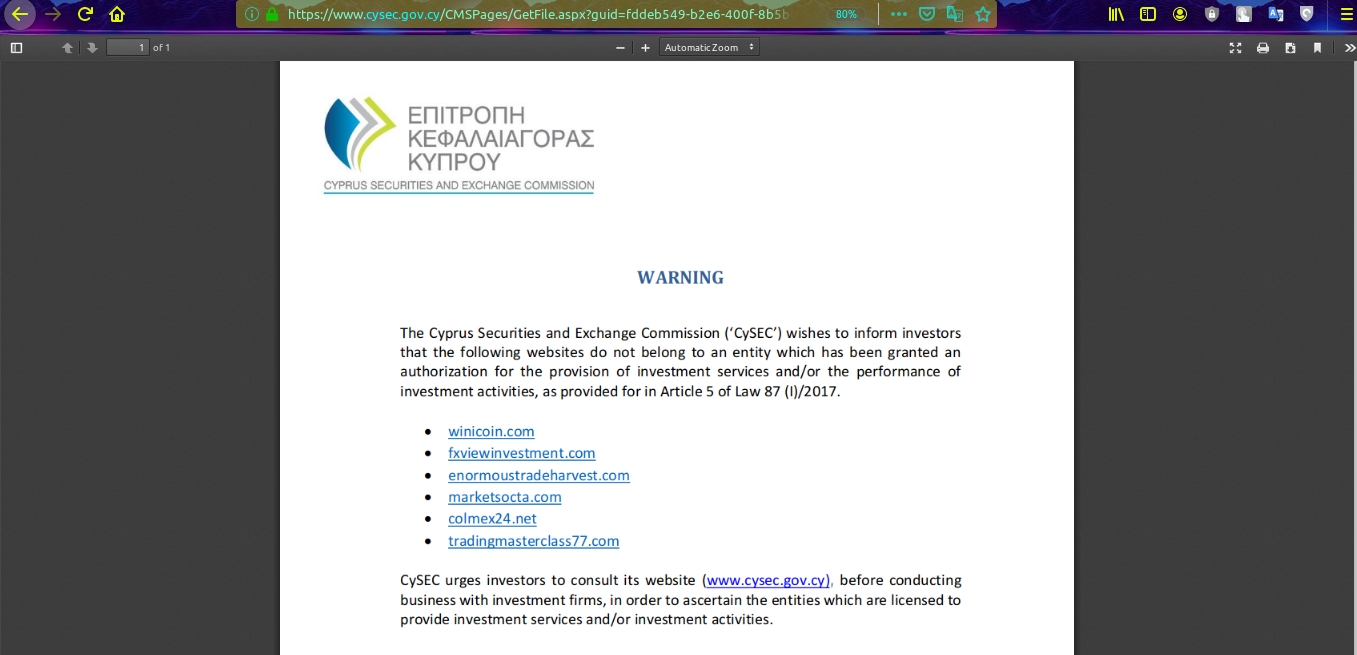
Otherwise, as we already said, the website looks convincing enough to mislead unaware traders who might be tempted by the seemingly attractive trading conditions and the neat and orderly layout of the presentation. That could easily be explained however, by the fact that MarketsOctaFX is using not only the logo and the brand of OctaFX, but also whole sections of the legit broker’s content.
On top of that MarketsOctaFX claims to be licensed in the UK ever since 2005 and to be trusted by well over 1 million traders around the world, which of course is a blatant lie as well given the fact that they are just a clone website exposed as a scam by CySEC in Cyprus.
Not to mention that MarketsOctaFX is actually operated by a virtually anonymous, opaque, offshore company called Markets Octa Limited, presumably based in St. Vincent and the Grenadines.
What are the risks of trading with unregulated brokers?
The main risk of dealing with unregulated brokers is associated with your ability to withdraw funds from your trading account. Basically you won’t be allowed to withdraw even a single penny once you have been tricked into depositing as much as you can.
And that could be expected given the fact that unregulated brokers by definition are based offshore and are not supervised by any official regulatory authority like for example the Financial Conduct Authority (FCA) in the UK, the Cyprus Securities and Exchange Commission (CySEC) or let say the Australian Securities and Exchange Commission. To make the long story short, unregulated brokers are completely unaccountable for the way they handle your funds.
Regulatory frameworks around the world
In the following paragraphs you may check the basic regulatory requirements across the most popular markets:
Regulatory framework in the European Union
The forex industry in the EU is governed under the guidelines of the European Securities and Markets Authority (ESMA) – the pan European financial regulator, according which each broker servicing the EU market should be licensed and authorized by one of the official financial regulators of the 27 EU member states, like for example CySEC in Cyprus or BaFin in Germany. After obtaining such a license, through a process of formal passportization the broker will be able to target clients anywhere in the EU.
Аll EU brokers are required to hold at least 730 000 EUR in operational capital, with which to guarantee all outstanding payments towards traders, as well as to give them negative balance protection, meaning that no one will risk loosing more money than what he or she has deposited.
>>Best EU Forex Brokers<<
Finally, all traders in the EU can benefit from client compensation schemes, which cover at least 20 000 EUR of the money in your trading account and which will be paid back to you in the unlikely event your broker files for bankruptcy.
In an attempt to minimize the trading risks the European Securities and Markets Authority (ESMA) has also imposed leverage caps – 1:30 for major currency pairs, 1:20 for non- major currency pairs, gold and major indices, 1:10 for commodities other than gold and non- major equity indices, 1:5 for individual equities and other reference values and 1:2 for crypto currencies.
Regulatory framework in the United Kingdom
All forex brokers in the UK are required to register with the local Financial Conduct Authority (FCA), which basically oversees all companies offering financial services in the country.
The regulatory requirements of FCA clоsly match those in the EU – brokers have to keep their clients funds in segregated accounts, to give the negative balance protection and to hold the equivalent of at least 730 000 EU as a minimum operational capital.
In addition the Financial Services Compensation Scheme in the UK basically insures your trading account for up to 85 000 GBP in the rare event your broker happens to be insolvent.
In an attempt to limit the potential loses to traders, in October 2020 the FCA banned the sale of crypto currency derivatives. Otherwise the same leverage restrictions apply as in the EU.
>>Best UK Forex Brokers<<
Regulatory framework in Australia
All Australian brokers should be licensed and authorized by the Australian Securities and Investments Commission (ASIC) – a reputable institution, which basically has the same regulatory requirements, including the leverage caps, as those applied in the EU and the UK, with the sole exception of the minimum operational capital and compensation schemes. In Australia all brokers should be holding at least 1 million AUD, with which to cover their payments towards traders.
>>Best Australian Forex Brokers<<
Regulatory framework in the United States
The U.S. forex market is probably the most strictly regulated one, as all U.S. brokers are required to hold at all times no less than 20 000 000 USD in registered capital – a formidable amount which kind of explains why only a handful of really big brokerage companies are authorized to target American customers.
You should be aware however, that traders in the U.S. are not protected by client compensation schemes, nor are they granted negative balance protection, which means that with certain instruments, you may end up losing more money than you have deposited.
Otherwise the leverage cap for retail clients is set at 1:50.
Take a note as well, that any broker which claims to be based on the U.S. should also be licensed as a futures commission merchant (FCM) and a foreign exchange dealer (FED) by the Commodity Futures Trading Commission (CFTC) as well as to be accepted as a member of the National Futures Association (NFA). So if you can not find your new “U.S.” broker in the registers of the above mentioned institutions, it is obviously not to be trusted.