Here is what StockValo has to say about its regulation:

There are two claims here – that it is licensed by the CySEC, the body that oversees the markets in Cyprus, and that it holds the permission of the UK’s regulator, the FCA, to offer its services to clients in Britain, despite not being directly licensed by it. Both of these are lies – here is why:
The CySEC has published the following warning against the broker:
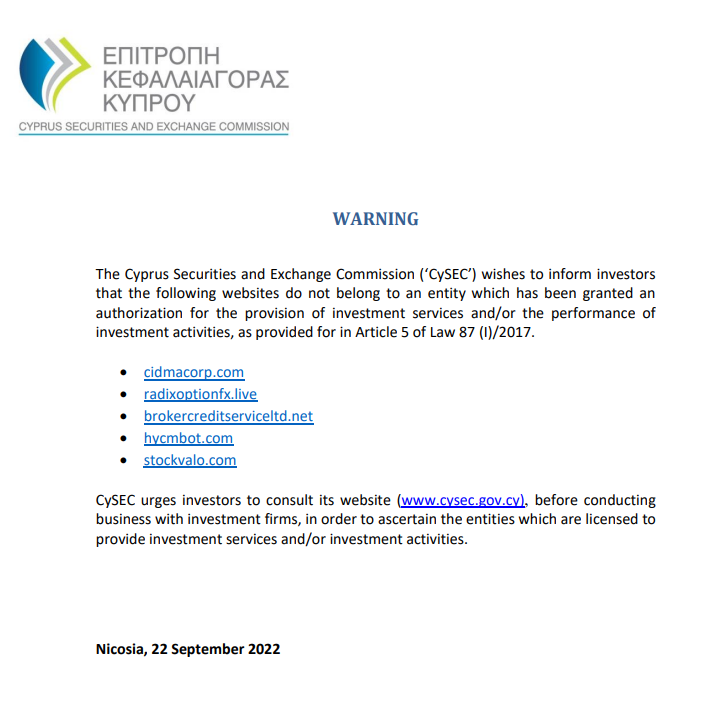
It states the firm is not authorized by it and should be avoided. Secondly, the FCA has allowed some brokers to deal on the UK market post-Brexit if they have a license in the EU, even if they are not licensed by the FCA. Note that, since StockValo lies about having such license, the FCA cannot have authorized it either. Therefore, this is simply another offshore broker that claims to be regulated by respected authorities like these two to gain the trust of their victims. Unregulated firms are always dangerous to deal with and should be avoided!
Why trading with offshore brokers is to be avoided
Offshore brokers often operate with the explicit goal of defrauding you. That is possible because such companies, not being under anyone’s oversight, are able to just take your deposits and misuse them, often times stealing as much as they can. However, even without the threat of a scam, an offshore broker is dangerous to the funds of its clients – these firms are not operating with sufficient capital and good enough leadership to stay afloat on a market as competitive as the Forex one. This is why you need to make sure the firm you are trading with is licensed by the Canadian IIROC – the regulator that watches over the Canadian markets:
>>Best IIROC-licensed brokers<<
The regulatory regime in Canada
Here is how the IIROC framework is designed to ensure that brokers licensed under it can stay afloat:
Firstly, the brokers that are licensed with the regulator are required to hold upwards of 250 000 Canadian dollars. This is done to ensure that clients will not have to deal with the firm being run into the ground due to poor leadership and a lack of liquidity, which is the usual case with offshore brokers. In such events of default, it is the clients who bear huge losses – all of their money gets swept up by the broker’s creditors.
And even in the unfortunate and unlikely even that a Canadian broker goes under, its clients will be able to rely on compensation funds. These restore up to 1 million Canadian dollars to affected clients. This means that you will be entitled to a hefty compensation. Brokers in other countries are also required to participate in guarantee funds, which usually restore smaller sums of money. For reference, the compensation EU clients can expect is of up to €20 000 per person.